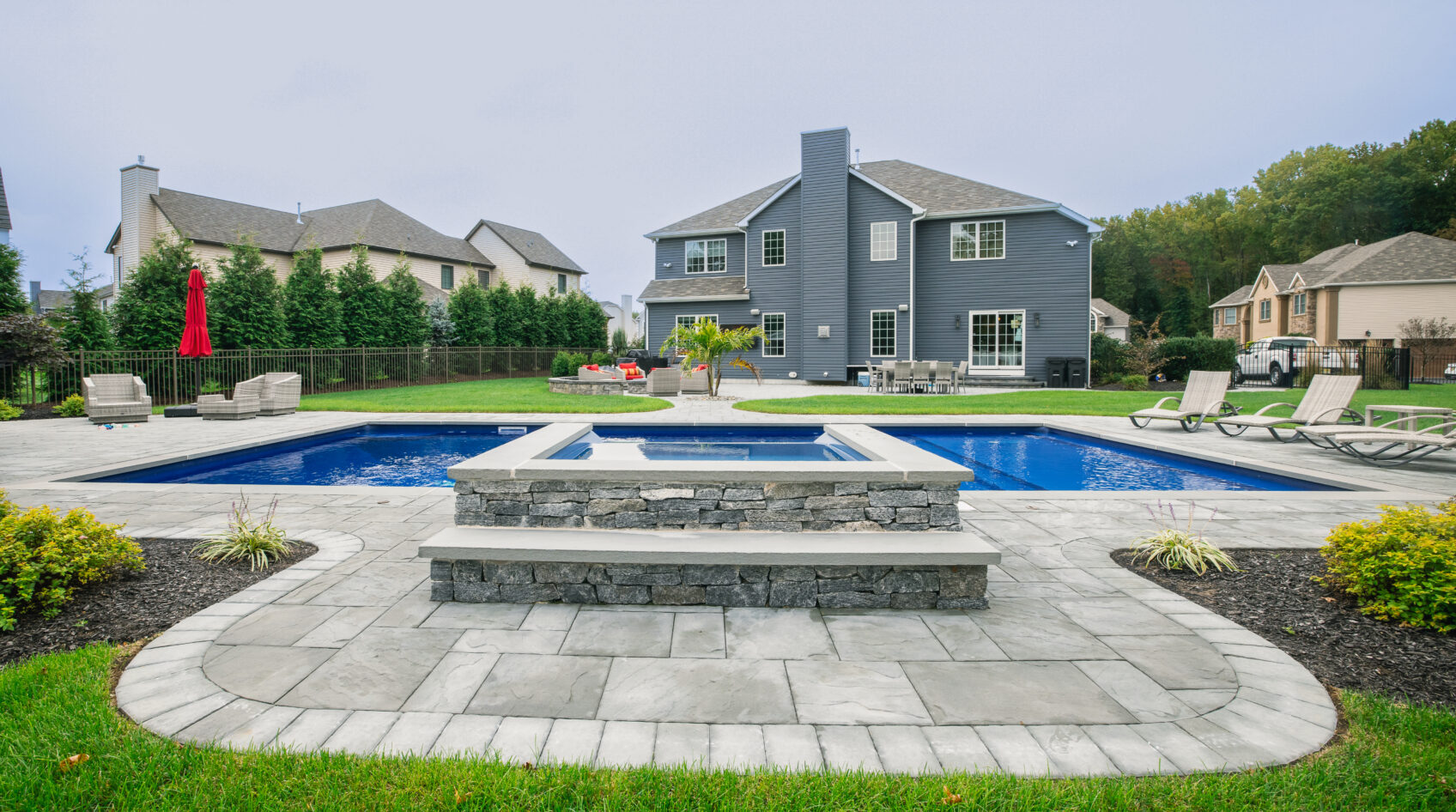
Custom pool coping offers landscape architects an extraordinary opportunity to shape the character of a waterscape. With the right material and fabrication, the pool edge can feel deliberate, architectural, and uniquely tailored to its setting.
Custom fabrication, however, introduces a level of complexity that demands clear communication. Unlike standard dimensional products, custom coping pieces must be fabricated precisely to match the designer’s vision. When specifications are incomplete or ambiguous, fabricators are forced to interpret details that should have been defined from the start.
This can result in delays, remakes, or installation challenges that ripple through the entire project schedule.
For designers working with custom coping, the most effective way to ensure precision is straightforward: communicate specifications with clarity and consistency before fabrication begins.
Why Clear Specifications Matter
Stone fabrication is both a craft and a technical process. Even with advanced CNC equipment and modern templating systems, the final product still depends on the information provided by the design team.
When specifications are incomplete-perhaps the edge profile is assumed rather than stated, or thickness tolerances are not clearly defined-the fabricator needs to fill in the gaps with assumptions. Those assumptions, however, may not always align with the design intent.
Clear documentation eliminates uncertainty. It allows the fabricator to produce each coping unit exactly as intended and ensures the installation team receives material that fits the projects conditions without modification.
In short, precision in specification leads directly to precision in fabrication.
Thickness: The Foundation of the Detail
Coping thickness influences more than structural performance; it also defines the visual weight of the pool edge.
Thicker coping can give the pool a grounded, architectural aesthetic, particularly in larger landscapes. Thinner profiles, by contrast, produce a lighter and more contemporary appearance.
Because coping thickness affects both fabrication and installation, it should always be specified explicitly. Designers should clarify:
- Nominal thickness (for example, 1 1/2″, 2″, or 2 1/4″)
- Whether thickness must remain consistent across all pieces
- Any required tolerances for dimensional variation
Without this information, fabricators may default to standard stock thicknesses that differ from the intended design.
Finish: Performance and Appearance
Surface finish is another specification of the stone that must be clearly communicated. The finish determines not only the appearance of the stone but also its slip resistance, texture, and light reflectivity.
Common coping finishes may include:
- Thermal finishes, which create a textured, slip-resistant surface ideal for wet environments
- Honed finishes, which provide a smoother, more refined appearance
- Sandblasted finishes, offering subtle texture while maintaining visual uniformity
Because each finish interacts differently with water and sunlight, designers should specify the exact treatment rather than relying on general descriptions.
A single project might even use different finishes for coping and adjacent decking to balance safety and aesthetic goals.
Edge Details: Defining the Character of the Pool
Edge profiles are among the most visually defining aspects of pool coping. They are also, however, one of the most common sources of fabrication confusion when not clearly documented.
Designers should specify the exact edge detail required, such as:
- Bullnose edges, offering a rounded, traditional appearance
- Eased edges, providing a subtle bevel that soften sharp corners
- Square-cut edges, creating a crisp, modern profile
In addition to naming the profile, it is helpful to indicate the radius or bevel dimension where applicable. Even small differences can significantly affect the appearance of the finished edge.
Providing a simple profile diagram alongside the specification can can remove any ambiguity.
Dimensional Tolerances: Managing Natural Variation
Natural stone fabrication includes minor dimensional variation. Rather than leaving those variations undefined, designers should establish acceptable tolerances as part of the specification.
Typical tolerances might include:
- Thickness variation: within ± 1/16″
- Length and width variation: within ± 1/16″ to ± 1/8″
- Edge alignment consistency: particularly important for square or eased profiles
Specifying these limits helps fabricators understand the level of precision required and ensure installers can maintain consistent joint spacing during placement.
For highly refined projects, requesting calibrated stone or shop drawings can further reduce the risk of dimensional discrepancies.
Preventing Costly Remakes
Fabricating custom coping is a time-intensive process. Once stone has been cut, profiled, and finished, corrections can be difficult or impossible without starting again.
Remakes introduce additional fabrication costs, extend project timelines, and may delay the installation of surrounding hardscape elements.
Most of these issues can be avoided through a straightforward pre-fabrication review process:
- Confirm all coping dimensions and profiles
- Review shop drawings provided by the fabricator
- Verify material selection and finish treatments
- Ensure dimensional tolerances align with installation requirements
These checkpoints allow the design team and fabricator to confirm alignment before any material is cut.
Collaboration as a Path to Precision
Custom pool coping projects are ultimately collaborative efforts. Designers establish the vision, fabricators translate that vision into stone, and installers ensure it performs in the field.
Clear specifications serve as the common language connecting those roles. They eliminate uncertainty, streamline production, and help ensure the finished pool edge reflects the designer’s original intent.
When thickness, finish, edge detail, and dimensional tolerances are communicated thoughtfully, the fabrication process becomes more efficient, and the results are far more predictable.
In the end, precision in communication leads to precision in craftsmanship, and that precision is what allows the pool edge to feel deliberate and refined.
Quality design deserves quality materials. Partner with Braen Supply to source reliable stone, veneer, and pavers tailored to your project requirements.
About the Author
Written in the voice of Braen Supply’s in-house expert persona, Gabriel Shaw. Shaw embodies the collective knowledge of our team and shares practical, straightforward tips to help landscape professionals make the most of their landscaping and masonry projects – drawing on decades of experiences serving New Jersey and the tri-state area.