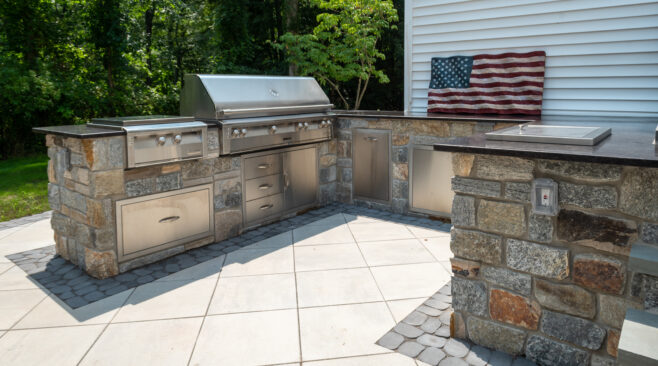
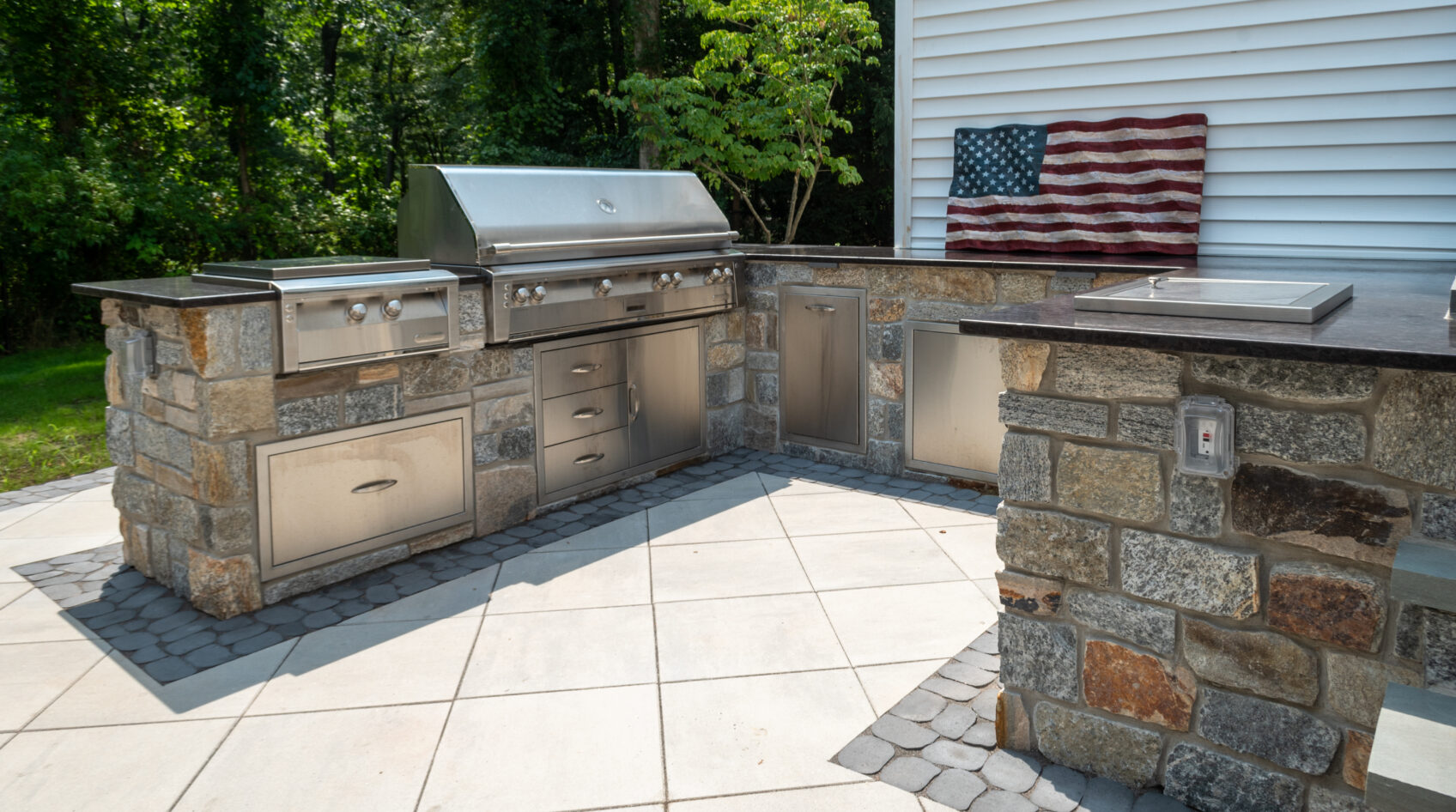
An outdoor kitchen can completely change the way you enjoy your backyard. From grilling dinner on a summer evening to hosting friends and family for a weekend barbecue, having a dedicated outdoor cooking space makes entertaining easier and more enjoyable.
But if you’ve started researching outdoor kitchens, you’ve probably noticed one thing pretty quickly: The costs can add up.
Between appliances, countertops, stone veneer, patio materials, and installation, it’s easy to get carried away with features that look beautiful but may not be necessary for the way you actually use your space.
The good news? You don’t need an unlimited budget to create an outdoor kitchen that looks great and functions well.
The key is knowing where to invest your money and where you can make more budget-friendly choices without compromising the overall design.
Whether you’re planning a simple grilling station or a fully equipped outdoor entertaining area, here are some practical ways to make the most of your outdoor kitchen budget.
1. Splurge on a Quality Grill You’ll Actually Use
The grill is usually the centerpiece of an outdoor kitchen, so it’s one area where spending a little more can make sense.
After all, if you plan to cook outside regularly, you want equipment that performs reliably and suits your cooking habits.
Look for an outdoor-rated grill with the features you’ll realistically use.
Consider factors such as cooking surface size, temperature control, burner configuration, warranty coverage, and the availability of replacement parts.
You don’t necessarily need the largest or most expensive grill on the market.
For example, if you’re usually cooking for two to four people, a moderately sized grill may be more practical than a professional-style model designed for large gatherings.
Likewise, specialty features may not be worth the additional expense if you don’t expect to use them regularly.
Where to splurge: Invest in a dependable grill with suitable construction, useful features, and accessible service support.
Where to save: Skip oversized models and specialty accessories that don’t match your cooking habits.
2. Save with a Simple Outdoor Kitchen Layout
One of the easiest ways to manage your outdoor kitchen budget is to keep the layout simple.
A straight-line outdoor kitchen, sometimes called a single-wall kitchen, can be a practical and attractive option.
This layout arranges the grill, countertops, and storage along one continuous counter.
Because the design is relatively straightforward, it may require fewer structural materials and less complicated utility routing than a larger L-shaped or U-shaped kitchen.
For example, a simple grilling station with preparation space on either side can provide everything you need for casual outdoor cooking.
You can always create a more elaborate entertaining atmosphere with surrounding patio furniture, landscaping, and lighting.
L-shaped and U-shaped kitchens can be beautiful, but additional counter sections, appliances, and utility connections can increase the total project cost.
Where to splurge: Make sure the layout provides comfortable circulation, appropriate appliance clearances, and enough preparation space.
Where to save: Choose a compact, efficient design instead of building more counter space than you’ll realistically use.
3. Splurge on Proper Installation and Structural Support
Some outdoor kitchen expenses aren’t particularly exciting, but they’re among the most important.
A beautiful kitchen won’t be much fun if the structure shifts, water collects around the base, or appliances aren’t installed correctly.
Depending on the design, an outdoor kitchen may require a dedicated foundation, structural support, drainage provisions, and properly installed utility connections.
Gas, electrical, and plumbing work should be completed by qualified professionals in accordance with applicable codes.
For homeowners in Northern New Jersey, freeze-thaw conditions and seasonal moisture make proper site preparation especially important.
If your outdoor kitchen will be installed on an existing paver patio, don’t assume the patio can support the structure without additional work.
The foundation requirements depend on the kitchen’s weight, construction, and site conditions.
Where to splurge: Invest in appropriate foundations, drainage, safe utility connections, and professional installation.
Where to save: Avoid unnecessary structural complexity and plan utility locations early to reduce avoidable changes during construction.
4. Save by Choosing Stone Veneer Strategically
Stone veneer can give an outdoor kitchen a beautiful, custom appearance, but you don’t necessarily need the most expensive material to achieve the look you want.
Both natural and manufactured stone veneer offer a variety of colors, textures, and profiles.
Natural stone veneer provides authentic texture and variation, making it a popular choice for homeowners who prefer traditional or rustic designs.
Manufactured stone veneer can offer a wide range of design options, including contemporary linear profiles and traditional stone-inspired textures.
Depending on the product, installation requirements, and local material costs, one option may be more budget-friendly than another.
Rather than choosing based on price alone, compare the complete installed cost.
Material thickness, weight, substrate preparation, installation labor, and finishing details can all influence the budget.
You can also create visual interest without introducing several different stone products.
For example, using one complementary stone veneer throughout the kitchen base can create a cohesive appearance.
Where to splurge: Choose an exterior-rated veneer system that’s appropriate for your project and professionally installed.
Where to save: Compare natural and manufactured veneer options, limit unnecessary material changes, and select a style that complements your existing patio.
5. Splurge on Countertops That Suit Outdoor Conditions
Countertops are another area where material selection matters.
Outdoor kitchen counters are exposed to sunlight, rain, temperature changes, spills, and everyday food preparation.
A countertop that looks beautiful indoors may not be suitable for year-round exterior exposure.
Certain natural stones and other exterior-rated countertop materials can be good options, but performance varies by product.
Some materials may require sealing or additional maintenance, while others may be sensitive to staining, UV exposure, or temperature changes.
Before choosing a countertop, review the manufacturer’s recommendations for outdoor use.
Also consider how you’ll use the surface.
If you frequently prepare meals outdoors, having adequate, easy-to-clean counter space may be more valuable than choosing a premium decorative finish.
Where to splurge: Invest in a countertop material that’s appropriate for outdoor exposure and your maintenance preferences.
Where to save: Keep the counter dimensions practical, avoid unnecessary cutouts, and choose a straightforward edge profile.
6. Save on Appliances You Don’t Really Need
It’s easy to get inspired by outdoor kitchens featuring pizza ovens, refrigerators, sinks, ice makers, and multiple cooking stations.
But before adding every appliance to your wish list, think about how often you’ll actually use each one.
For many homeowners, a quality grill and adequate preparation space are enough for everyday outdoor cooking.
A refrigerator can be convenient, but it may not be necessary if the kitchen is located close to the house.
The same goes for a sink.
While an outdoor sink can make food preparation and cleanup easier, it may also require additional plumbing, drainage, and winterization.
Specialty appliances can be wonderful additions, but they can significantly increase the project budget.
Where to splurge: Prioritize the appliances that support your everyday cooking habits.
Where to save: Skip specialty equipment and extra utility connections that won’t provide enough practical value.
7. Splurge on a Well-Designed Paver Patio
Your outdoor kitchen is only one part of the overall space.
The surrounding patio plays a major role in how comfortable, functional, and attractive the finished project feels.
A properly designed paver patio can provide a beautiful foundation for cooking, dining, and entertaining.
Concrete pavers are available in a wide range of colors, textures, and sizes, making it possible to coordinate the patio with your outdoor kitchen’s stone veneer and countertops.
However, the appearance of the pavers is only one consideration.
Proper base preparation, drainage, and installation are essential, especially in areas that experience seasonal freezing and thawing.
For homeowners working with an existing patio, it may be possible to incorporate a new outdoor kitchen without replacing the entire surface.
However, the patio should be evaluated to determine whether modifications or additional structural support are needed.
Where to splurge: Prioritize proper patio construction, drainage, and materials suitable for the intended use.
Where to save: Choose attractive standard paver styles instead of elaborate custom patterns, and reuse suitable existing hardscaping when practical.
8. Save with Simple, Coordinated Finishing Details
A beautiful outdoor kitchen doesn’t need complicated decorative features.
In fact, some of the most attractive designs use a relatively simple combination of materials.
For example, an outdoor kitchen finished with neutral stone veneer, a complementary countertop, and coordinating patio pavers can create a polished appearance without relying on expensive accents.
You can also add personality through outdoor furniture, planters, and lighting.
These elements are often easier to update over time than permanent masonry features.
If your budget is limited, focus on completing the main kitchen and patio first.
Additional landscaping, decorative lighting, or lounge furniture can be introduced later as your budget allows.
Where to splurge: Invest in a cohesive material palette and quality finishing details that affect the permanent structure.
Where to save: Avoid unnecessary decorative upgrades and introduce nonessential accessories over time.
9. Splurge on Smart Planning Before Construction Begins
One of the most effective ways to save money on an outdoor kitchen is to make important decisions before installation starts.
Changing appliance sizes, relocating utility connections, or switching materials after construction begins can create additional expenses.
Start by establishing a realistic budget and identifying your priorities.
Think about which features you need immediately and which ones could be added later.
If you plan to expand the kitchen in the future, discuss those possibilities with your contractor during the initial design phase.
For example, planning for a future refrigerator or additional electrical outlet may be easier before the patio and kitchen structure are completed.
However, any utility rough-ins should be designed and installed by qualified professionals according to applicable requirements.
Where to splurge: Invest time in planning, accurate measurements, and coordination between contractors and suppliers.
Where to save: Reduce unnecessary changes, avoid overbuilding, and phase nonessential features when practical.
Outdoor Kitchen Budget: Where to Save vs. Where to Splurge
| Outdoor Kitchen Feature | Where to Save | Where to Splurge |
|---|---|---|
| Grill | Skip oversized models and unused features | Quality, reliability, and appropriate size |
| Layout | Choose a simple straight-line design | Functional preparation space and safe clearances |
| Foundation | Avoid unnecessary complexity | Structural support and drainage |
| Stone veneer | Compare material and installation options | Exterior-rated products and proper installation |
| Countertops | Keep dimensions and edges simple | Outdoor suitability and durability |
| Appliances | Skip unnecessary specialty equipment | Frequently used essentials |
| Patio pavers | Choose standard styles and patterns | Base preparation and installation |
| Finishing details | Add decorative accessories later | Cohesive permanent materials |
| Planning | Avoid last-minute design changes | Accurate layout and utility coordination |
How Much Should You Budget for an Outdoor Kitchen?
Outdoor kitchen costs can vary considerably depending on the size, materials, appliances, and installation requirements.
A simple grilling station with limited counter space will generally cost less than a fully equipped outdoor kitchen with multiple appliances, plumbing, and custom masonry.
The surrounding patio can also affect the overall budget.
If you already have a suitable patio, you may be able to focus more of your investment on the kitchen itself.
If you’re starting from scratch, you’ll need to account for site preparation, hardscape installation, and any necessary utility work.
When establishing your budget, it’s helpful to separate the project into three categories:
Essentials: The features required for the kitchen to function safely and comfortably, such as the grill, appropriate structural support, usable counter space, and necessary utilities.
Design priorities: Materials and finishes that contribute to the appearance of the kitchen, including stone veneer, countertops, and patio pavers.
Optional upgrades: Features such as beverage refrigerators, pizza ovens, bar seating, decorative lighting, and additional storage.
This approach can help you identify where to allocate more of your budget without sacrificing the features that matter most.
It’s also wise to reserve a contingency for unexpected site conditions or construction changes.
Can You Build an Outdoor Kitchen in Phases?
Absolutely. For homeowners working with a limited budget, building an outdoor kitchen in phases may be a practical option.
For example, you might begin with a properly constructed patio and a simple grilling station.
Later, you could add outdoor furniture, landscaping, lighting, or other amenities.
However, phased construction requires careful planning.
Permanent structures, foundations, and utility connections should be designed with the intended final layout in mind.
Adding a sink, refrigerator, or other built-in appliance later may be difficult if the necessary infrastructure wasn’t considered during the initial project.
Discuss your long-term plans with your contractor before construction begins to determine which features can reasonably be added later.
Create a Beautiful Outdoor Kitchen Without Overspending
Building an outdoor kitchen on a budget doesn’t mean sacrificing style or functionality.
It’s about making thoughtful decisions that prioritize the features you’ll use most while choosing materials and layouts that complement your home.
A simple outdoor kitchen with a quality grill, attractive stone veneer, and a well-designed paver patio can be just as inviting as a much larger installation.
By investing in proper construction, choosing materials carefully, and avoiding unnecessary upgrades, you can create an outdoor space that fits both your lifestyle and your budget.
At Braen Supply, we offer a variety of natural and manufactured stone veneer, patio pavers, and other hardscape materials to help homeowners bring their outdoor kitchen designs to life.
Our team can help you compare colors, textures, and product options to find materials that complement your project goals and budget.
Frequently Asked Questions About Budget-Friendly Outdoor Kitchens
1. What is the cheapest outdoor kitchen layout?
A straight-line outdoor kitchen is often one of the most budget-friendly layouts because it uses a single counter section and can require fewer materials and less complicated utility routing than larger configurations. A simple grilling station with preparation space and storage may be sufficient for many homeowners.
2. Is natural stone or manufactured stone veneer cheaper for an outdoor kitchen?
Manufactured stone veneer may have a lower material cost than certain natural stone products, but this isn’t always the case. The final price depends on the specific product, installation labor, substrate requirements, and finishing details. Comparing complete installed costs is the best way to evaluate your options.
3. Can I build an outdoor kitchen on my existing paver patio?
Possibly. An existing paver patio may be suitable for some outdoor kitchen designs, but the structure’s weight, foundation requirements, and utility connections must be considered. A contractor should evaluate the patio before installation to determine whether additional support or modifications are necessary.
4. What outdoor kitchen features are worth spending more money on?
Features worth prioritizing often include a reliable grill, appropriate structural support, properly installed utilities, exterior-rated countertops, and suitable hardscape materials. These elements contribute to the kitchen’s everyday functionality and long-term performance. Optional appliances and decorative upgrades can often be added later.
5. How can I make a budget outdoor kitchen look expensive?
Choose a cohesive color palette, coordinate your stone veneer with the surrounding patio pavers, and keep the layout simple. Thoughtful finishing details, comfortable furniture, and attractive lighting can help create a polished appearance without requiring an elaborate kitchen design.